
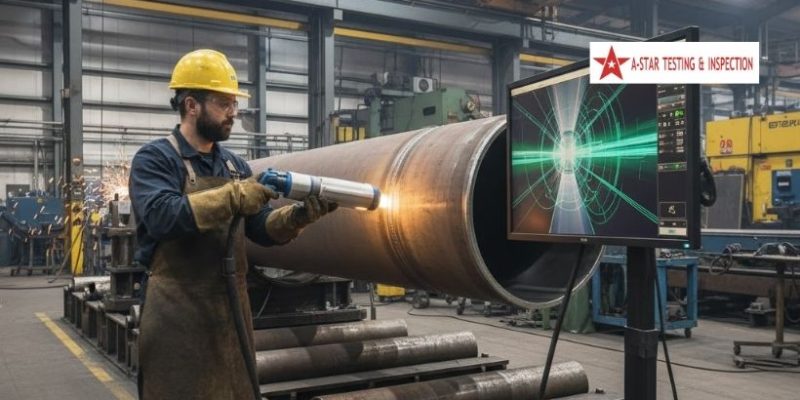
In the critical world of asset integrity, safety, and effective operation, quality inspection methods are vital. Non-Destructive Testing (NDT) offers the necessary tool to conduct inspections on components without destroying them, and a new, powerful technology is changing the way this is done: Real-Time Radiography (RTR). RTR is fast establishing itself as an industrial inspection standard in some of the crucial industries in Malaysia, such as oil and gas, marine, and power generation. Its ability to provide real-time images has challenged the limits of conventional radiation tests and has provided considerable benefits in terms of time and accuracy. Are you willing to know how this groundbreaking technology is transforming the new standard in NDT services? Now we shall enter into the details of RTR.
What is the Real Time Radiography?
Real Time Radiography (RTR) or live imaging or real-time radioscopy is an advanced, non-destructive evaluation method that gives a dynamic image of radiography of a test object in real-time.
Unlike traditional or Computed Radiography, where the film or phosphor plates are needed, which then have to be processed and scanned so as to view the image, RTR depends on the electronic detectors that capture the radiation and then directly convert it into a digital X-ray inspection image. This fundamental distinction permits live defects inspection and inspection since the internal structure of a component can be observed as it is being exposed to radiation, in essence, a digital video feed as opposed to a photographic image.
How Real-Time Radiography Works
The principle of operation of the Real Time Radiography requires a limited number of parts: source of X-ray, detector, and live imaging screen.
This is initiated by an X-ray tube (or an isotope source) that emits the radiation that penetrates through the test object. The attenuated X-rays instead of hitting a film, strike a complex digital imaging panel (usually a flat panel detector or an image intensifier). Such a detector automatically transforms the X-ray energy to an electronic signal, which is subsequently processed and represented as a high-resolution image on a monitor through a special control system.
This translates to instant visualization of defects by the inspector, the ability to manipulate to enhance the clarity of the image, and to adjust the location of the equipment to provide the best views, all at the same time the inspection is proceeding to provide instant results.
Key Applications of Real-Time Radiography
The speed and efficiency of RTR have rendered it suitable for a wide range of industrial inspection work, especially when large amounts of inspection or speed are involved.
- Pipeline Inspection: This is widely used as a method of inspection of new weld joints to identify discontinuities in them, and as a method of checking on the integrity and wall loss of pipelines of existing pipelines.
- Corrosion Under Insulation (CUI): RTR is very efficient in identifying and evaluating CUI on insulated vessels and piping without removing the insulation, incurring huge time and cost savings.
- Weld Inspection: Quick screen and detailed inspection of the defects of welding in fabrication shops and on-site construction.
- Pressure Vessel Inspection: The inspection of the inner state and searching for defects in the important pressure-retaining devices.
- Offshore and Marine Components: Inspection of offshore structures and other components in which the reduction of downtime is paramount in terms of industrial maintenance.
Benefits of Real-Time Radiography
The use of RTR has many benefits over the old systems, which would improve the productivity and safety of any project:
- Quicker response and immediate output: The images can be accessed immediately, which saves the time between the inspection and repair significantly.
- No film processing required: Does not require chemical developers in the processing, and therefore is greener than chemical processing, and also does not require a darkroom because the process is time-consuming.
- Less downtime and efficiency: The high rate of inspection makes it possible to complete large-scale projects faster, which enhances operational efficiency.
- Less dangerous inspection with reduced exposure: Digital detectors can often provide a lower dose of radiation and with reduced exposure time, which results in less radiation than film.
- Economical to large-scale projects: Fewer man-hours, reproducible digital media, and the are no consumables would lead to a general cost saving of large-scale inspections.
Comparison to other Radiography Methods
| Feature | Real Time Radiography (RTR) | Film Radiography (RT) | Computed Radiography (CR) |
| Imaging | Instant / Live Digital Feed | Permanent Analog Film | Digital after scanning the phosphor plate |
| Speed | Fastest (Faster Inspection) | Slowest (requires processing) | Moderate (requires plate scanning) |
| Consumables | None | High (Film, Chemicals) | Minimal (Reusable phosphor plates) |
| Clarity & Convenience | High, manipulable image, immediate results | High, but static image, requires a darkroom | High, digital image, more flexible than film |
Real Time Radiography vs Film Radiography: The main distinction here is that RTR is instant and digital, and thus has no need to process the film as fast and chemical-laden as is the case with film, so it is the best form of inspection technology when speed is a factor.
Real Time Radiography vs Computed Radiography: These two types of radiography are digital in nature, but the difference between them is that RTR can produce a live image. CR remains in a delay mode when scanning the phosphor plate, whereas RTR is able to give an immediate, continuous view and is more convenient and faster in making on-the-spot evaluations.
Standards & Safety Regulations
The use of Real Time Radiography in industrial environments that have high stakes is highly controlled by the international and national standards to deliver reliability and radiation protection. Key standards include:
- ASME Section V: Offers rules of non-destructive examination processes, such as RTR.
- API 1104: This is specific to the welding of pipelines and associated facilities, and it has provisions of using digital radiographic methods.
- ISO 17636-2: Provides methods of radiographic inspection of welds through the use of digital detectors.
A-STAR Testing and Inspection is a strict follower of these codes. Quality is supported by our certification, such as the ISO 9001, and our adherence to all the local radiation safety requirements. Our ground operations are handled by very competent inspectors who have undergone the highest levels of certification; hence, all the inspections are done safely and to standard.
Real Time Radiography in Malaysia: A-STAR’s Expertise
In its effort to become the market leader in the provision of NDT services in Malaysia, A-STAR Testing & Inspection has embarked on the use of advanced RTR systems in offering excellent asset integrity solutions. The combination of our local competency and a global network puts us in a unique position to manage the complex needs of Malaysian industries.
We have the best RTR equipment with high-resolution flat panel detectors and portable X-ray sources that enable us to provide good and precise inspection even where it is difficult such as offshore platforms and low space. Data integrity and high-quality industrial inspection services are guaranteed by the training of our team of NDT specialists and professionally certified employees, which is specific to advanced digital methods.
Frequently Asked Questions
Q1. What is Real Time Radiography used for?
Ans: RTR is primarily used for the detection and sizing of internal flaws like cracks, voids, inclusions, and wall loss (corrosion/erosion) in materials such as welds, castings, and piping systems.
Q2. Is Real Time Radiography safe?
Ans: Yes. Modern RTR systems are designed with radiography safety in mind. They often require lower radiation doses and shorter exposure times than conventional RT, leading to smaller radiation exclusion zones and better protection for personnel.
Q3. What industries benefit the most?
Ans: Industries dealing with critical infrastructure and high-volume component inspection benefit the most, including Oil & Gas, Petrochemical, Marine/Shipbuilding, Power Generation, and Manufacturing.
Q4. How does RTR compare to traditional X-ray testing?
Ans: RTR (a type of digital X-ray testing) offers immediate image viewing, eliminating film and chemical processing, which results in faster inspections and superior digital image manipulation capabilities compared to traditional film radiography.
Conclusion:
Real-time radiography is not just a tool but a real breakthrough in the technology of inspection in NDT, as it offers unprecedented speed, safety, and accuracy. In the case of the industries in Malaysia where the safety and efficiency in their operations are directly related to the bottom line, RTR presents the obvious way to go in ensuring the integrity of the asset.
Do not allow the old-fashioned inspection methods to slow down your operations or jeopardize your safety standards. To have the power of RTR to provide professional, high-end industrial testing solutions.
Today, contact A-STAR Testing & Inspection and see how our state-of-the-art NDT capabilities will save you time, deliver safer and more reliable results on your project today.